What anti-ageing means
We don’t talk about freezing or reversing age — skin ages at its own pace, and what we do is slow it down
Ageing is layered
Dullness in the epidermis, collagen loss in the dermis, laxity in the fascial layer — each layer keeps its own timeline. Effective anti-ageing requires knowing which layer the problem sits in
Treat each layer
The superficial layers answer to light and regenerative infusion; the deep layers to radiofrequency and ultrasound. Putting the right energy at the right depth is what makes it a treatment — otherwise it is only a sensation
Gradual, not all at once
New collagen needs a cycle, and the barrier needs time. We prefer calibrating session by session and improving gradually — results that look natural and hold up over time
Skin analysis
Data first
A required first step at every new visit. Not the naked eye and not sales talk — the device and our professional team read your skin together first
Skin imaging
Multi-spectral imaging maps epidermal pigment, fine capillaries, pores and UV damage — revealing what the naked eye cannot see
In-person assessment by our team
Combining skin type, barrier condition and stage of ageing, our professional team reads the data and confirms your concerns before deciding whether to treat, and how
Written plan and records
Every analysis is kept on file for before-and-after comparison. Change in your skin deserves to be recorded, not recalled
Skin types
The first step in anti-ageing is a deep understanding of your own skin. Using a high-precision professional analysis system, we profile its condition from every angle and pin down exactly how your skin behaves
Dry skin
Low oil output and a stratum corneum that holds water poorly. Feels tight much of the time, prone to dry lines and fine creases, reactive to environmental change — needs deep nourishment and barrier repair
Oily skin
Active sebaceous glands leave the T-zone and face oily. Visible pores that clog easily into comedones and breakouts — though this skin tends to age more slowly and resists fine lines
Combination skin
Both dry and oily by turns: typically an oily T-zone with drier cheeks. The face divides clearly into zones and needs zone-by-zone care to balance water and oil
Sensitive skin
A fragile barrier that reacts readily to external triggers. Flushes, itches or stings easily, and calls for exceptionally gentle anti-ageing care with calming, repairing properties
Ageing & lax skin
Elastic fibres weaken as collagen is lost with time. Marked by fine lines, deep wrinkles, a blurred contour and localised hollowing — calling for precise deep lifting and collagen regeneration
Rosacea
Chronic skin inflammation · central faceCommonly known as rosacea — a chronic inflammatory skin condition affecting mainly the central face (cheeks, nose, forehead and chin)
- 01 Signs & symptoms— Persistent redness, dilated capillaries, papules, pustules, or burning and itching. If you notice these, have a professional confirm the diagnosis before planning any care
- 02 Causes— Medically understood as a mix of heredity and environment: abnormal vascular regulation, immune hypersensitivity, overgrowth of Demodex mites, and genetic factors
- 03 Common triggers— Temperature shifts, emotion and stress, unsuitable skincare, diet, and medication. Knowing your triggers and avoiding them is the first step in managing symptoms
A map of layered anti-ageing
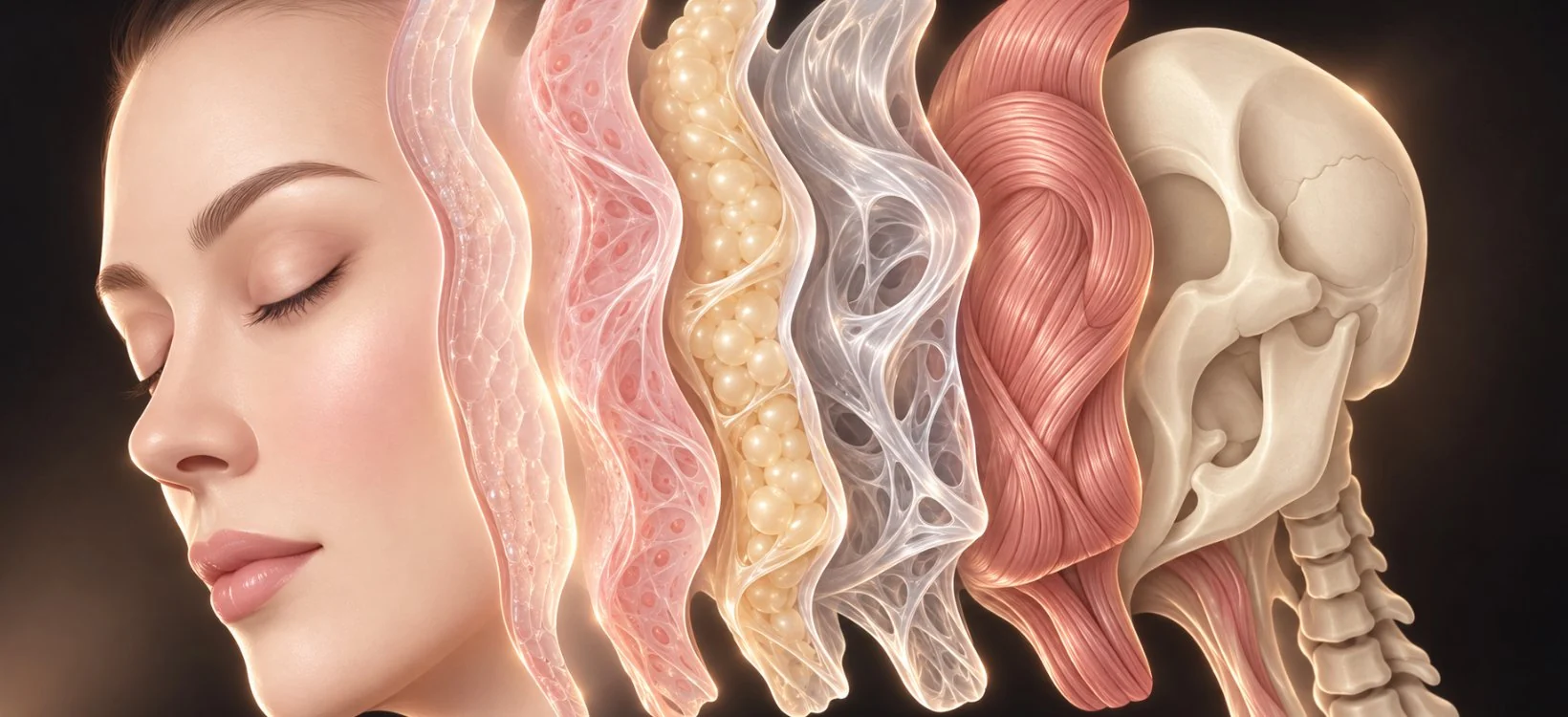
Skin is finely layered from surface to depth, and each layer ages by its own mechanism. Facial ageing is a three-dimensional, full-thickness process running from epidermis to bone
Layer-by-layer skin analysis
Surface to depth · five layers- Skin barrier— Ageing mechanism: secretion of the surface hydrolipidic film and the lipids between keratinocytes (ceramides among them) declines, markedly weakening the barrier that holds water in and keeps external irritants out. Visible signs: dehydrated, parched skin, flushing and reactivity, an oily yet flaking surface, and faster formation of dry lines.
- Epidermis & stratum corneum— Ageing mechanism: the epidermal renewal cycle lengthens, spent keratinocytes pile up in disarray, and the epidermis gradually thins. Visible signs: dull, lightless tone, rough uneven texture, pigment deposition and fine superficial lines.
- Papillary dermis— Ageing mechanism: the wavy dermal–epidermal junction (DEJ) flattens, so nutrient transfer becomes less efficient and the microvascular network shrinks. Visible signs: loss of underlying radiance and fullness, reduced metabolic repair, and early laxity.
- Reticular dermis— Ageing mechanism: within the thick reticular layer that carries vessels and follicles, collagen and elastin are lost in quantity, fragment and stiffen, and the support structure collapses. Visible signs: deep fixed wrinkles (nasolabial folds, forehead lines), loss of bounce and firmness, and pores stretched by lax surrounding tissue.
- Subcutaneous tissue— Ageing mechanism: the yellow cobblestone-like fat compartments shrink and are reabsorbed, sliding downward under gravity and widening the gaps between tissues. Visible signs: structural hollowing (temples, eye sockets, cheeks), mid-face collapse, a blurred jawline and a contour that has lost its shape.
Layer-by-layer contour analysis
From epidermis to bone · all six layers- Epidermis and dermis— Ageing signs: slower keratinocyte turnover, loss of collagen and elastin fibres, declining hyaluronic acid. Visible impact: dry, rough skin, fine lines, dull dehydrated tone and a loss of surface elasticity.
- Superficial subcutaneous fat— Ageing signs: gradual downward descent, loss or displacement under gravity, with widening gaps between compartments. Visible impact: nasolabial folds, marionette lines, downturned mouth corners and a blurred facial contour.
- SMAS (superficial musculoaponeurotic system)— Ageing signs: the fascial network that supports the whole face loses elasticity and the retaining ligaments slacken. Visible impact: fat can no longer be held in place, producing large-scale descent of the mid and lower face.
- Muscle layer— Ageing signs: repeated contraction leaves the muscles of expression over-toned, or atrophied with age. Visible impact: dynamic wrinkles (forehead lines, crow’s feet) that linger even once the face relaxes.
- Deep fat— Ageing signs: the deep fat pads shrink and are reabsorbed, ceasing to support the soft tissue above. Visible impact: hollow temples and eye sockets, flattened apple cheeks and sunken cheeks.
- Bone layer— Ageing signs: bone resorption and loss — the eye sockets enlarge while brow and jaw bone volume shrinks. Visible impact: the facial framework contracts, leaving the soft tissue above unsupported, causing deep collapse and overall laxity.
Everyday care
Good skin comes from careful daily care. A well-founded home routine supplies continuous nourishment and protection
Gentle cleansing & water–oil balance
Avoid over-cleansing that strips the hydrolipidic film; use a mildly acidic cleanser. Strengthen the stratum corneum’s water retention daily to keep the skin’s water–oil balance healthy
Round-the-clock sun protection
Photo-ageing is the single greatest driver of skin ageing. Wear sunscreen as a habit — rain or shine, indoors or out — to shield collagen from UV damage
Nourishment layer by layer
Choose daily care around your own skin type, built on proven actives — peptides, vitamin C, retinol (vitamin A) or hyaluronic acid — for precise everyday repair at the skin’s base
Aftercare
After light-based, microneedling or lifting treatments the skin enters a "golden window" of collagen remodelling and self-repair. The right care here multiplies the result
Three rules for the golden window
Universal · after any treatment- Intensive hydration & barrier repair— Metabolism speeds up after treatment and water evaporates faster. Use a simple, intensely hydrating mask and ceramide repair products on consecutive days to settle any dryness promptly.
- Rigorous sun protection & physical cover— Skin is more light-sensitive afterwards, so prioritise physical protection — wide-brimmed hats, parasols — and apply a gentle, purely physical sunscreen to prevent pigmentation.
- Handle gently & keep it simple— For one to two weeks afterwards, pause acids, alcohol, brightening and exfoliating products. Wash with lukewarm rather than hot water and avoid strenuous exercise and hot saunas — let the skin renew in the most comfortable conditions.
Injectables
Skin boosters · PN · collagen stimulation · filler- For 24 hours after treatment, avoid make-up, high-temperature environments (sauna, hot yoga) and strenuous exercise.
- Keep injection points clean; after six hours you may cleanse gently with water. Avoid scrubs and acids.
- Mild swelling or bruising is a normal response and usually settles in 1–3 days; use a cold compress as advised.
- For one week afterwards intensify hydration and sun protection, and pause retinol and high-concentration acids.
- Contact the clinic immediately if you have persistent pain, hardened lumps or unusual swelling.
Laser treatments
Laser 1064 · Pro Yellow · tightening devices- Mild redness and warmth after treatment are normal and usually subside within hours.
- For 24 hours avoid hot water and high temperatures — cleanse gently and hydrate generously.
- Let any scabs shed naturally — never pick. Avoid swimming pools and irritating products meanwhile.
- Strict sun protection for 14 days — physical sunscreen first, with a hat and sunglasses outdoors.
- Follow-up intervals follow your treatment plan, with settings adjusted by our professional team to your skin’s response.